In 2026, the local SEO landscape has moved beyond “star counts.” Search engines like Google and Bing along with generative AI tools like ChatGPT and Perplexity now “read” your reviews with the nuance of a human analyst.
This shift means that every word a customer writes becomes a data point for your business’s Entity Authority. Here is how AI is analyzing your reviews and what you need to do to rank high in an AI-driven world.
Table of Contents
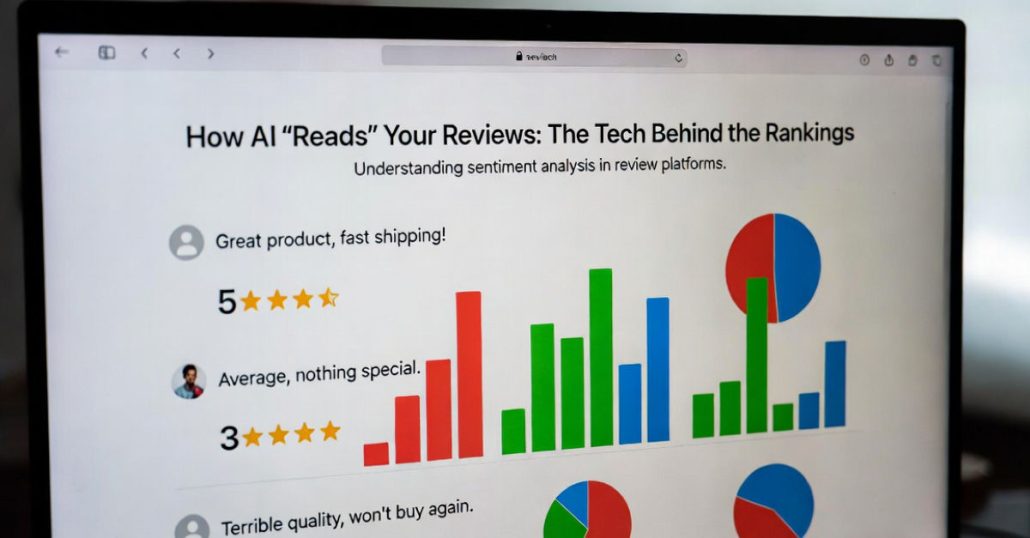
1. How AI “Reads” Your Reviews: The Tech Behind the Rankings
AI doesn’t just see a 5-star rating; it uses Natural Language Processing (NLP) and Sentiment Analysis to break down your reviews into three core components:
A. Semantic Extraction
AI scans reviews for specific “entities” (products, services, or staff names). If a customer writes, “The sourdough at Baker’s Delight is the best in Seattle,” AI links the entity [Sourdough] to [Baker’s Delight] in the location [Seattle]. This allows the AI to surface your business for long-tail queries like “Where can I get authentic sourdough nearby?” even if those words aren’t on your website.
B. Sentiment Deep-Diving
AI identifies the emotional tone of specific attributes. It can distinguish between a general positive review and a “high-value” one.
- Low Value: “Great place, loved it!” (Generic)
- High Value: “The service was fast, but the waiting area was a bit cramped.” (Specific) AI uses this to build a Business Profile Graph, categorizing your strengths (fast service) and weaknesses (cramped space) to better match you with user preferences.
C. Review Velocity and “Freshness”
In 2026, AI algorithms prioritize recency. If you haven’t received a review in over three months, AI agents may interpret your business as “inactive” or “declining,” leading to a silent drop in rankings regardless of your overall 4.8-star average.

2. The Impact on Your Rankings
Traditional SEO focused on keywords; Generative Engine Optimization (GEO) focuses on trust and intent.
- AI Overviews (AIO) & Citations: Google’s AI Overviews often pull “Proof of Quality” directly from reviews. If AI is summarizing why a user should visit you, it will quote specific review text as a citation.
- Zero-Click Conversions: AI assistants (like Gemini or Siri) now answer queries directly. If a review says, “They have a great outdoor patio for dogs,” the AI will answer the user’s question about “dog-friendly patios” without the user ever clicking your site.
- Filter Resilience: AI can now filter out “fluff.” Businesses with hundreds of 5-star reviews that lack detailed text are being outranked by businesses with fewer, but more descriptive, reviews that demonstrate E-E-A-T (Experience, Expertise, Authoritativeness, and Trustworthiness).
3. Best Practices: Feeding the AI What It Needs
To rank high in 2026, you need to treat your reviews as a “data feed” for AI.
Encourage “Specific” Feedback
Stop asking for “a review.” Ask for “feedback on [Specific Service].”
- Tip: When sending a follow-up email, include a prompt: “Tell us what you thought of your [Service Name] today!” This encourages the customer to use the keywords AI needs to categorize your business.
The “AI-Friendly” Response Strategy
Your responses are just as important as the reviews. AI analyzes your response pattern to gauge your professionalism and activity level.
- Use Natural Language: Avoid “canned” responses. AI can detect repetitive templates and may discount them as low-effort signals.
- Mirror the Keywords: If a customer mentions your “emergency plumbing service,” your response should include: “We’re glad we could get your emergency plumbing sorted so quickly!” This reinforces the keyword association for the AI.
Multi-Platform Consistency
AI “crawls” the entire web. It compares your reviews on Google to those on Yelp, Facebook, and niche industry sites (like Houzz or TripAdvisor).
- Strategy: Ensure your NAP (Name, Address, Phone) is identical everywhere. If AI finds conflicting data, it lowers your “Trust” score, which is a primary ranking factor.
Active “Q&A” Management
The “Questions & Answers” section of your Business Profile is now a massive AI signal.
- Action: Seed your own Q&A with common questions. Use conversational language like, “Do you offer vegan options for your catering?” This gives the AI structured data to pull from when answering user queries.
The Bottom Line: Adapting to the Algorithmic Eye
In 2026, your online reputation is no longer just a digital trophy case—it is a living dataset that informs every decision an AI agent makes about your business. The transition from “keyword matching” to “intent understanding” means that the nuance, detail, and frequency of your customer feedback now carry more weight than a simple five-star average. By encouraging descriptive reviews and responding with authentic, keyword-rich engagement, you aren’t just thanking your customers; you are teaching the AI exactly why your business is the most authoritative answer to a user’s next question. In this new era of search, the businesses that prioritize narrative quality over rating quantity will be the ones that stay at the top of the results.